Car Import Documentation: China to USA Guide 2025
Bringing a car from China into the United States sounds like an exciting move and Americans imported over 25,000 vehicles from China last year alone. Most people assume you just need a bill of sale and a shipping receipt. That could not be more wrong. The reality is the paperwork can trip up even experienced importers and a tiny error in documentation can actually cause customs to seize your car at the port. Keep reading to find out which forms actually matter and how to avoid the most common pitfalls.
Table of Contents
Quick Summary
Takeaway | Explanation |
|---|---|
Obtain All Essential Documents | Ensure you collect vehicle title, commercial invoice, and certificates of origin and export for compliance. |
Verify Compliance Before Import | Confirm that the vehicle meets EPA and DOT standards to avoid delays or rejections. |
Understand Potential Pitfalls | Identify common mistakes with documentation and finances to prevent costly consequences. |
Prepare Thoroughly for Submission | Organize all documents digitally and verify compliance with import regulations ahead of time. |
Engage Professional Import Experts | Consult with customs brokers and specialists to streamline the import process and reduce risks. |
Essential Car Import Documents from China
Importing a car from China requires meticulous documentation preparation. Navigating the complex landscape of car import documentation demands precision and understanding of specific regulatory requirements. Successful international vehicle importation hinges on assembling a comprehensive set of critical paperwork that demonstrates compliance with both Chinese export and US import regulations.
Vehicle Origin and Ownership Documentation
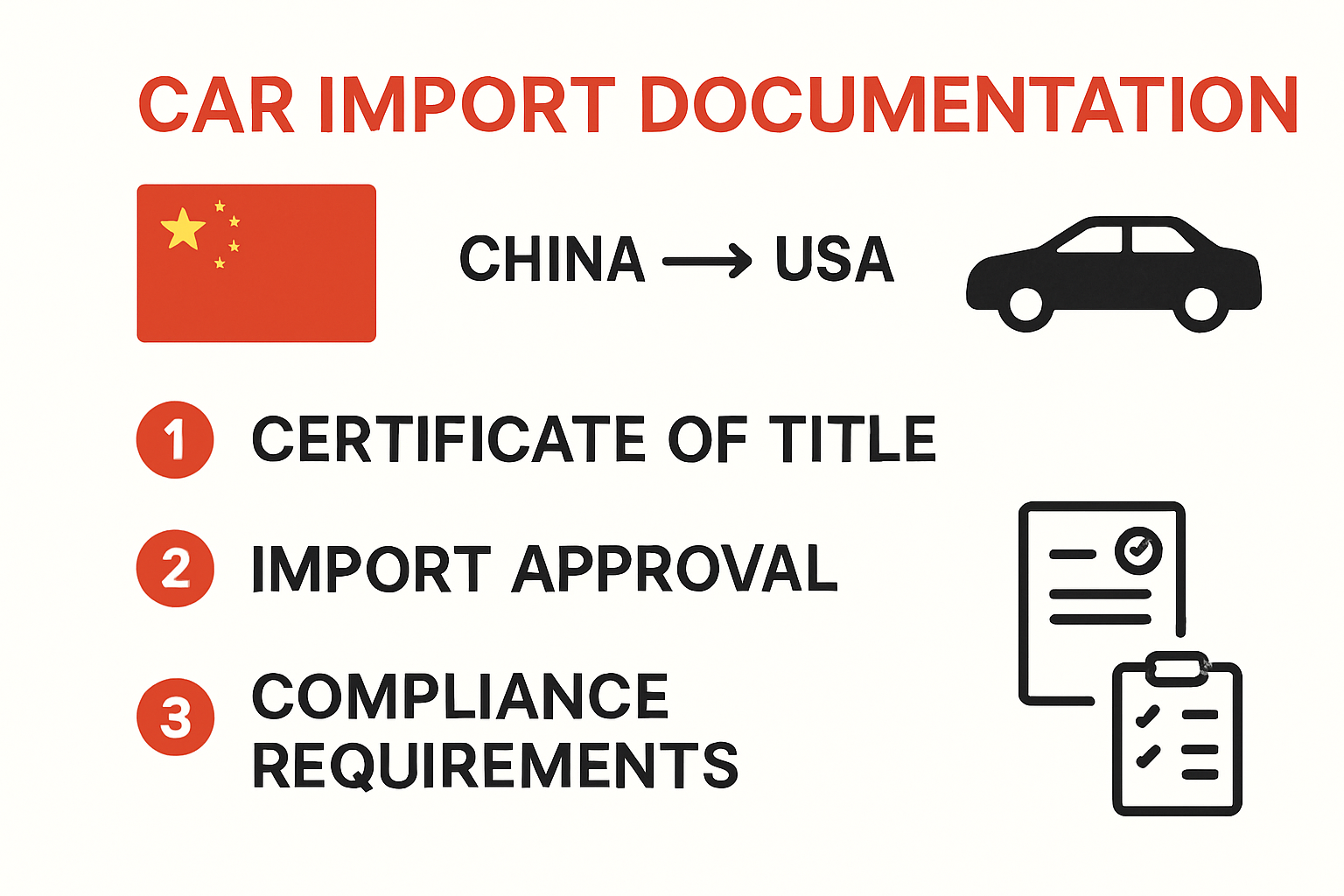
The foundation of car import documentation starts with proving vehicle ownership and origin. Importers must obtain original vehicle title documents directly from the Chinese manufacturer or seller. These documents typically include:
Commercial Invoice detailing the vehicle’s complete purchase information
Certificate of Origin verifying the vehicle’s manufacturing location in China
Export Certificate issued by Chinese automotive export authorities
According to US Customs and Border Protection, each imported vehicle must have a clear chain of ownership documentation that can be independently verified. The documentation must explicitly show the vehicle identification number (VIN), manufacturer details, and complete transaction history.
Compliance and Certification Paperwork
US automotive import regulations mandate strict compliance with safety and emissions standards. Importers must secure specific certification documents that demonstrate the vehicle meets Environmental Protection Agency (EPA) requirements. These critical documents include:
EPA Import Form 3520-1 confirming emissions compliance
DOT HS-7 Form verifying vehicle safety standards
Manufacturer’s Conformity Certificate proving technical specifications match US regulations
Each document serves as a critical checkpoint in the car import process. Incomplete or incorrect documentation can result in significant delays, potential vehicle seizure, or complete import rejection. Importers must work closely with both Chinese exporters and US import authorities to ensure every paperwork requirement is meticulously fulfilled.
The complexity of car import documentation from China requires thorough preparation, attention to detail, and a comprehensive understanding of international trade regulations. Successful importation depends not just on having the right documents, but presenting them in a manner that demonstrates full transparency and regulatory compliance.
To help clarify the specific import documents required and their purposes, the following table summarizes the essential paperwork for car importation from China to the USA:
Document | Purpose | Issued By / Requirement |
|---|---|---|
Commercial Invoice | Details vehicle purchase and transaction info | Chinese Seller/Manufacturer |
Certificate of Origin | Verifies vehicle manufacturing location | Chinese Manufacturer |
Export Certificate | Authorizes vehicle export from China | Chinese Automotive Export Authority |
EPA Import Form 3520-1 | Confirms emissions compliance (US requirement) | US Environmental Protection Agency |
DOT HS-7 Form | Verifies vehicle meets US safety standards | US Department of Transportation |
Manufacturer’s Conformity Certificate | Proves technical specs match US regulations | Vehicle Manufacturer |
Step-by-Step Car Import Process Explained
Importing a car from China involves a structured sequence of procedures that require careful planning and precise execution. The process demands strategic coordination between exporters, importers, shipping companies, and government regulatory agencies.
Pre-Import Preparation and Verification
Before initiating the car import process, importers must complete several critical preliminary steps. First, verify the specific vehicle meets all US import regulations. According to US Customs and Border Protection, this includes confirming the vehicle complies with safety, emissions, and technical standards.
Key pre-import verification steps include:
Vehicle Compliance Check: Confirm the car meets EPA and DOT standards
Import Eligibility Assessment: Determine if the specific vehicle model is permitted for import
Cost Calculation: Evaluate total import expenses including duties, taxes, and shipping
Careful preliminary research helps prevent costly import complications. Environmental Protection Agency regulations are particularly stringent, requiring meticulous documentation and technical verification of each imported vehicle.
Shipping and Customs Clearance Process
Once pre-import requirements are satisfied, the actual shipping and customs clearance process begins. This multi-step procedure involves several critical stages:
Select an international shipping method (container shipping or roll-on/roll-off)
Prepare comprehensive shipping documentation
Arrange maritime or air transportation
Clear customs at the US port of entry
Pay applicable import duties and taxes
Customs officials conduct thorough inspections to ensure full regulatory compliance. Incomplete or inaccurate documentation can result in significant delays or potential vehicle rejection. Importers must work closely with experienced shipping agents who understand international automotive import regulations.
Successful car import from China requires patience, meticulous planning, and a comprehensive understanding of complex international trade requirements. Each step demands precision and careful attention to regulatory details to ensure a smooth vehicle importation experience.

To further clarify the process, the table below summarizes the step-by-step car import process and key requirements at each stage:
Step | Description | Key Requirement |
|---|---|---|
1. Vehicle Compliance Check | Ensure EPA & DOT standards are met | Compliance confirmation |
2. Import Eligibility Assessment | Verify if model is import-permitted | Reference US import guidelines |
3. Cost Calculation | Estimate total costs (duties, taxes, shipping) | Detailed financial planning |
4. Select Shipping Method | Choose container or roll-on/roll-off | Suitability for vehicle type |
5. Prepare Shipping Documentation | Gather all necessary paperwork | Document completeness |
6. Arrange Transportation | Schedule maritime/air shipment | Alignment with timing and regulations |
7. Customs Clearance | Clear US customs at port of entry | Accurate, complete documentation |
8. Pay Duties and Taxes | Settle all applicable import fees | Funds and currency ready |
Common Mistakes and How to Avoid Them
Importing a car from China involves numerous potential pitfalls that can derail the entire process. Understanding and anticipating these common mistakes can save importers significant time, money, and frustration.
Documentation and Compliance Errors
Documentation represents the most critical area where importers frequently encounter challenges. Maersk highlights several key documentation mistakes that can significantly impact the import process.
Common documentation errors include:
Incorrect Harmonized System (HS) Codes: Misclassifying vehicle types can lead to incorrect duty calculations
Inaccurate Country of Origin Information: Failing to precisely document the vehicle’s manufacturing origin
Incomplete Supporting Documents: Missing or partial documentation can halt the entire import process
Customs and Border Protection emphasizes that even minor documentation errors can result in significant delays, potential fines, or complete shipment rejection. Importers must meticulously verify every document before submission.
Financial and Regulatory Missteps
Financial miscalculations can transform a potentially profitable import into a costly nightmare. According to PCBUSA, importers frequently underestimate the total cost of importing a vehicle from China.
Key financial and regulatory mistakes include:
Underestimating Import Duties: Failing to accurately calculate total import taxes and fees
Ignoring Customs Bond Requirements: Not securing proper financial guarantees for import
Misunderstanding Rules of Origin: Incorrectly interpreting regulations governing vehicle imports
Professional customs brokers recommend creating a comprehensive financial plan that includes:
Detailed duty and tax calculations
Shipping and insurance costs
Potential modification expenses to meet US regulations
Contingency funds for unexpected challenges
The complexity of car import documentation from China requires a proactive approach. Successful importers invest time in understanding regulations, consulting experts, and preparing comprehensive documentation. While mistakes can be costly, careful preparation and attention to detail can streamline the import process and minimize potential risks.
Ultimately, successful car importation is about more than just moving a vehicle across borders. It requires a strategic approach that combines thorough research, precise documentation, and a deep understanding of international trade regulations.
Tips for Faster Car Import Approvals
Navigating the complex landscape of car import approvals requires strategic preparation and meticulous attention to detail. Importers can significantly expedite their vehicle import process by implementing targeted strategies that streamline documentation and regulatory compliance.
Comprehensive Pre-Submission Preparation
Advance preparation is the cornerstone of faster car import approvals. US Customs and Border Protection recommends developing a comprehensive documentation strategy well before initiating the import process.
Key preparation strategies include:
Digital Document Organization: Create digital copies of all required documents with high-resolution scans
Proactive Compliance Verification: Conduct thorough pre-screening of vehicle specifications against US import regulations
Professional Translation Services: Ensure all Chinese documents are professionally translated into English
Environmental Protection Agency guidelines emphasize the importance of complete and accurate documentation. Importers who invest time in meticulous preparation can reduce potential review and clearance delays.
Leveraging Professional Import Expertise
Engaging with experienced customs brokers and import specialists can dramatically accelerate the approval process. These professionals understand the intricate nuances of international vehicle importation and can help navigate complex regulatory requirements.
Recommended expert support includes:
Hiring a licensed customs broker
Consulting with automotive import specialists
Obtaining pre-clearance consultations
Utilizing industry-specific compliance advisors
Professional experts can help identify potential documentation gaps, recommend precise compliance strategies, and provide strategic guidance throughout the import process. Their insider knowledge can potentially reduce processing times and minimize the risk of regulatory complications.
Successful car import approvals demand a proactive, detail-oriented approach. By combining thorough preparation, expert guidance, and comprehensive documentation, importers can significantly streamline their vehicle importation experience from China to the United States. Learn more about our import support services to further optimize your import strategy.
Remember that each vehicle import is unique. While these strategies can improve approval speed, individual cases may vary based on specific vehicle characteristics, regulatory changes, and current customs protocols. Flexibility and continuous communication with import authorities remain crucial throughout the process.
Frequently Asked Questions
What documents are required to import a car from China to the USA?
To import a car from China, you need essential documents such as the original vehicle title, commercial invoice, certificate of origin, export certificate, EPA Import Form 3520-1, DOT HS-7 form, and the manufacturer’s conformity certificate.
How can I ensure my car meets US import regulations?
To ensure compliance, verify that the vehicle meets EPA and DOT standards by conducting a vehicle compliance check, including emissions compliance and safety standards verification.
What are the common mistakes to avoid when importing a car from China?
Common mistakes include incorrect Harmonized System (HS) codes, inaccurate country of origin information, incomplete supporting documents, and underestimating import duties and taxes.
How can I expedite the car import approval process?
You can expedite the approval process by organizing digital copies of your documents, proactively verifying compliance with regulations, and seeking assistance from professional customs brokers and automotive import specialists.
Overcome the Headaches of International Car Import Documentation
Struggling with complicated paperwork when importing your EV or petrol car from China? The article made it clear that even one small error in your car import documentation or a missing EPA or DOT form can put your investment at risk and expose you to long delays at US Customs. Tired of worrying about chain of ownership proof, export certifications, or whether your compliance forms will hold up on arrival? You are not alone. Many importers feel frustrated and overwhelmed trying to make sense of US import rules while ensuring every piece of documentation is correct and complete.
You do not have to face customs paperwork nightmares on your own. Get the peace of mind and expert guidance you need for a fast and smooth import with Nomad Cars. Our team specializes in exporting both electric and petrol vehicles from China and provides step-by-step documentation support to help you avoid the most common mistakes explained in this guide. Ready to save time and protect your investment? Visit Nomad Cars now or explore how our services simplify the import process for your next vehicle. Partner with experienced professionals and let us handle the details so you can drive into the future with confidence.


Комментарии
Отправить комментарий