Toyota Hilux 4 by 4 The Definitive Explainer
The Toyota Hilux 4 by 4 isn't just another pickup truck; it's a global byword for unstoppable durability and reliability. You could think of it as the ultimate automotive multi-tool, just as capable on rugged back-country trails as it is handling heavy-duty work on the world’s toughest job sites.
Why the Hilux 4 by 4 Is a Global Legend
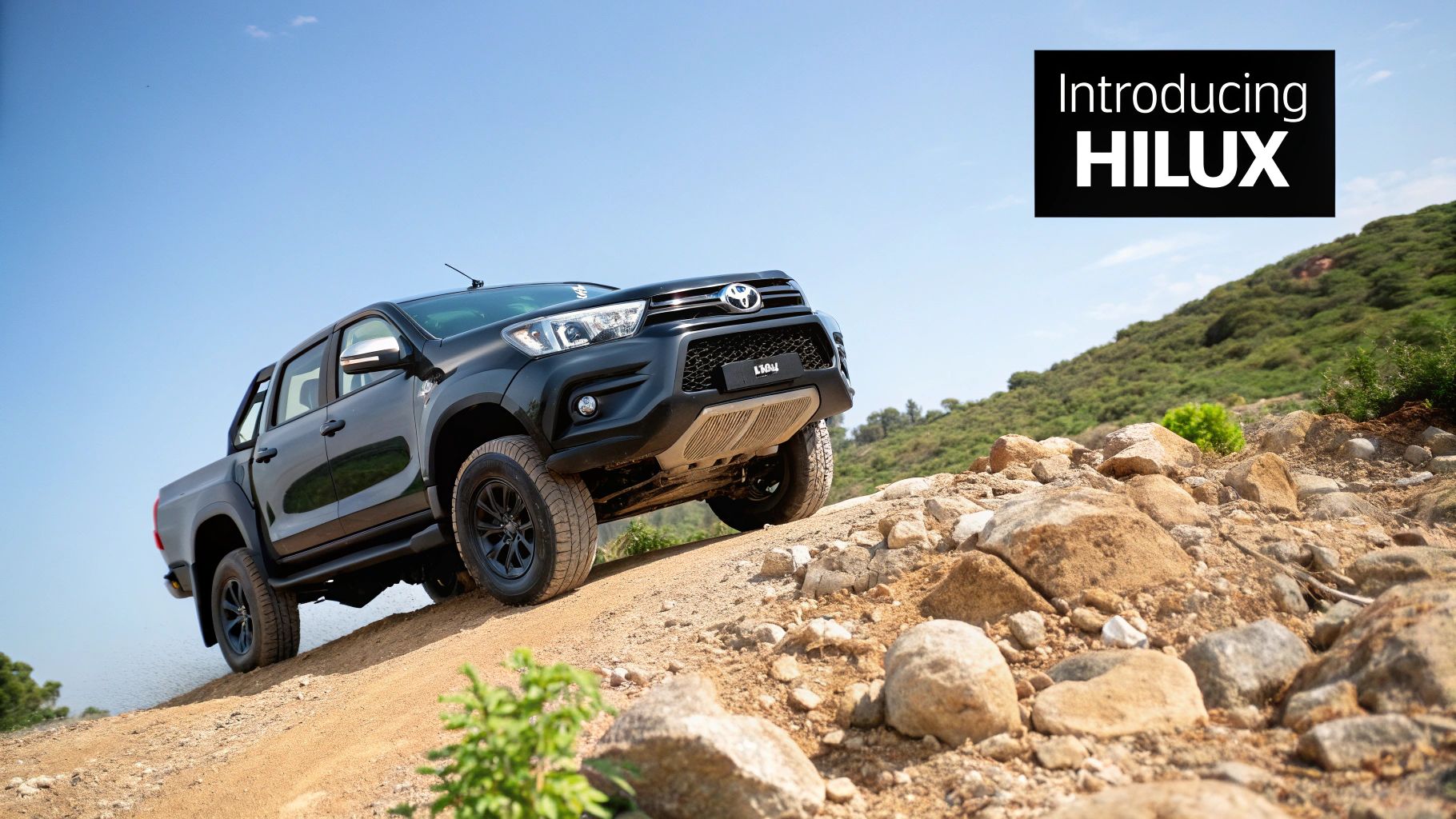
For decades, the Toyota Hilux has carved out a reputation that’s second to none. This is a vehicle that was practically forged in the most demanding conditions you can imagine, from the blistering heat of deserts to the biting cold of frozen tundras. Its legend wasn't built in a marketing office; it was earned through real-world proof.
At its core, the Hilux makes a simple promise: it will get the job done, regardless of what stands in its way. This fundamental toughness is precisely why the Toyota Hilux 4 by 4 is the go-to vehicle for adventurers, farmers, construction crews, and organisations where vehicle failure simply isn’t an option.
The Foundation of Toughness
So, what’s the secret behind the Hilux's famous resilience? It all starts with its body-on-frame construction. Picture a solid, rigid ladder built from high-strength steel—that's the chassis. The truck’s body is then mounted securely on top of this separate frame.
This classic engineering approach delivers two massive advantages:
Superior Strength: It can shoulder heavy payloads and withstand the immense twisting forces that come from driving over rough, uneven ground, all without risking its structural integrity.
Durability and Repairability: The tough frame takes the brunt of the abuse, shielding the cabin and making the vehicle much easier to repair after years of hard use.
This design philosophy is a huge reason why you can still find Hilux models from the 1980s chugging along and working hard in remote corners of the world. Its mechanical simplicity is a deliberate feature, not a flaw, prioritising a long service life over overly complex and fragile systems.
A Legacy Proven by Numbers
The Hilux's worldwide dominance isn't just a collection of stories; the staggering production and sales figures tell the same tale of universal trust. Its massive presence in the 4x4 pickup market, especially in regions with demanding terrain like Algeria, speaks volumes about its sustained performance.
Since Toyota kicked off its global IMV project, the Hilux has been built in 18 countries and sold in over 180 countries. By 2017, cumulative global sales had already blown past 17.7 million units since its launch in 1968. You can explore the detailed history of its global impact and see how these numbers reflect its enduring reliability.
The Hilux is more than a vehicle; it's a partner. It’s the one tool you know you can count on when you're miles from the nearest workshop—a quality that's priceless in challenging environments.
In this guide, we'll dive deep into what truly makes this truck a legend. We'll explore its specific capabilities, break down the different model variations, and give you practical advice if you're looking to buy one through a service like Nomadcars, cementing its status as the definitive choice for any challenge.
Choosing Your Hilux 4 by 4 Model
Picking the right Toyota Hilux 4 by 4 isn't just about buying a truck; it's about choosing a reliable partner for whatever you plan to throw at it. The sheer number of Hilux models can feel a bit overwhelming at first, but it’s this variety that makes it so adaptable. Let's break down the options to help you find the perfect fit, whether it's for hard work, family life, or off-road adventures here in the DZ region.
Your first big decision is the body style, also known as the cab configuration. This is the most important choice you'll make, as it sets the balance between passenger space and cargo capacity. Essentially, you're deciding what the truck's main job will be.
Cab Configurations: The Practical Trade-offs
The core choice boils down to a Single, Extra, or Double Cab. Each one is built for a different kind of owner.
Single Cab: This is the undisputed workhorse of the lineup. With just two doors and seating for a driver and one or two passengers, its design is all about maximising the load bed. That long, uninterrupted cargo area is perfect for hauling tools, building materials, and heavy equipment, making it the go-to for commercial and agricultural work.
Extra Cab (or Space Cab): Think of this as the smart compromise. The Extra Cab gives you a small, secure, and weatherproof area right behind the front seats. While some models come with small "jump seats," this space is really best for stashing valuable tools, luggage, or supplies you want to keep out of the elements. It offers more versatility than a Single Cab without committing to the four full doors of a Double Cab.
Double Cab: There’s a reason this is the most popular and versatile option. With four proper doors and comfortable seating for up to five adults, it masterfully blends the utility of a pickup with the convenience of a family SUV. It’s the perfect do-it-all vehicle, easily switching from a worksite machine during the week to a family adventure wagon on the weekend.
Choosing the right cab is all about being honest about your day-to-day needs. A tradesperson will almost always lean towards the massive utility of a Single Cab, while a family that loves weekend getaways will find the Double Cab to be an absolute necessity.
To help you visualise the differences, here is a simple comparison of how each body style stacks up for common uses in the DZ market.
Toyota Hilux 4 by 4 Body Style Comparison
Body Style | Primary Use Case | Passenger Capacity | Cargo Bed Length | Best For |
|---|---|---|---|---|
Single Cab | Pure Commercial/Work | 2-3 | Longest | Tradespeople, farmers, and fleet operators who need maximum cargo space. |
Extra Cab | Mixed Use / Secure Storage | 2 + 2 (occasional) | Medium | Owners who need more secure cabin storage for tools or gear than a Single Cab offers. |
Double Cab | Multi-purpose / Family | 5 | Shortest | Families, adventure-seekers, and business owners who need a vehicle for both work and personal life. |
Ultimately, the best configuration is the one that aligns with your lifestyle. The Double Cab offers the most flexibility, but if pure hauling power is your goal, nothing beats a Single Cab.
Understanding Trim Levels: From Utility to Comfort
Once you’ve locked in a body style, it's time to look at the trim level. Think of it like upgrading your toolkit—the basic function is the same, but higher trims give you more capability, comfort, and better features. Trim names often change depending on the market (you might see SR, SR5, Revo, or Invincible), but the ladder of progression is always similar.
Base models are all about pure, rugged function. They come with durable, easy-to-clean interiors, the essential tech you need, and the tough-as-nails mechanicals that built the Hilux legend. They're designed to take a beating and keep on going.
Move up to mid-range trims, like the very popular SR5, and you’ll find a great balance of comfort and capability. This is where you start seeing upgrades like alloy wheels, chrome exterior touches, better infotainment systems, and more driver-assistance features. These models are for owners who want a more pleasant daily drive without sacrificing any of that legendary off-road grit.
Top-tier trims are all about the premium experience. They load the truck with luxury features, advanced safety systems, and often come with more aggressive, head-turning styling.
This image shows a typical hierarchy, climbing from a tough utility model to a fully-loaded, premium off-roader.
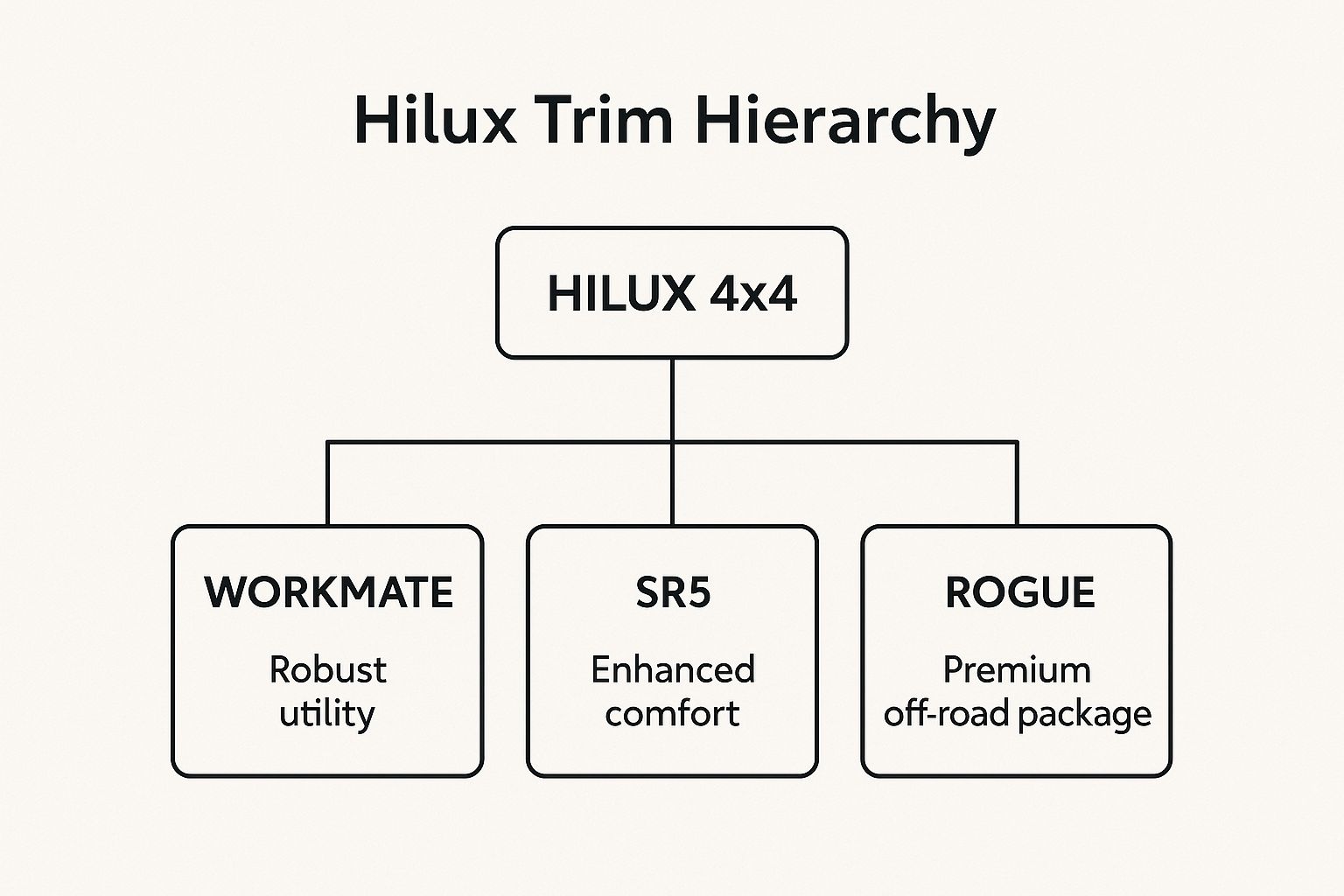
As you can see, each level builds on the one before it, letting you perfectly match a set of features to your budget and what you want from your truck.
The real secret is to match the model and trim to how you'll actually use it. There's no point paying for features you'll never touch, but it's just as frustrating to find your truck isn't equipped for the jobs you need it to do.
Your final decision will come down to a balance between your budget, your intended use, and the level of comfort you’re after. To see what specific models and trims are available for import, you can explore a wide variety of vehicles. For more information, check out our listings for the Toyota brand on Nomadcars.
How the Hilux 4 by 4 Conquers Tough Terrain
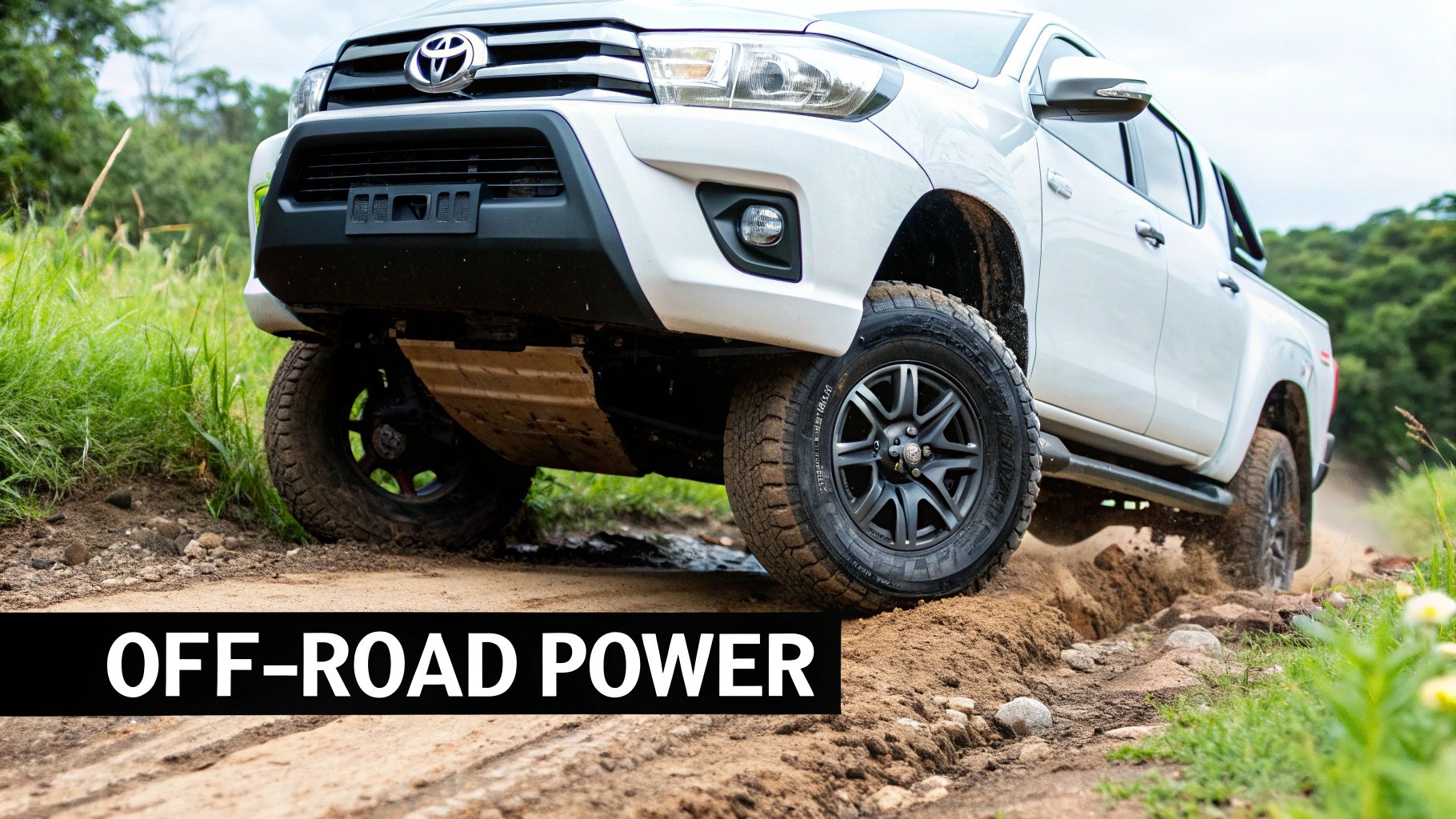
The legendary toughness of the Toyota Hilux 4 by 4 isn't just about having a beefy frame. It’s really about the smart engineering and mechanical systems working together to master the wild. Getting your head around how these features work is the key to unlocking the truck’s real potential when the pavement ends. It's like a mechanical orchestra, where every part plays a vital role in delivering grip, stability, and sheer climbing force.
At the heart of it all is the selectable four-wheel-drive system. Don't think of it as a simple "on/off" switch. Instead, picture it as a toolbox with three distinct tools for three very different jobs, letting you perfectly match the truck's behaviour to the ground beneath you.
This adaptability is what makes the Hilux so famously capable, whether you're on a smooth highway or a sketchy mountain track. Knowing which mode to use, and when, is the first step to becoming a truly confident off-road driver.
Mastering the Selectable 4WD System
The beauty of the Hilux's system lies in its simplicity. A straightforward dial lets you pick between three modes, each engineered for a specific purpose.
H2 (Two-Wheel Drive High Range): This is your daily driver mode. It sends power just to the rear wheels, which is perfect for asphalt and other high-grip surfaces. Sticking to H2 for normal driving saves fuel and reduces unnecessary wear and tear on your 4WD components.
H4 (Four-Wheel Drive High Range): When things get a bit slippery, H4 is your go-to. This mode engages all four wheels, splitting power between the front and back axles. It’s ideal for gravel roads, wet tarmac, or light snow, giving you a huge confidence boost with extra traction and stability at regular speeds.
L4 (Four-Wheel Drive Low Range): Now we're talking. L4 is your ace in the hole for serious off-roading. It engages a lower set of gears, which acts as a torque multiplier. Think of it like trying to push open a heavy, resistant door. Pushing near the handle is like H4, but pushing near the hinges is L4—you get immense leverage. This mode is essential for crawling up steep hills, ploughing through deep mud or soft sand, and navigating over large rocks.
Switching into L4 completely changes the Hilux's personality. It transforms from a capable pickup into a slow, methodical crawler, giving you the raw power and fine control needed to tackle the toughest obstacles. While some competitors offer similar systems, the Hilux’s proven reliability is what sets it apart. Of course, it's always smart to see what else is out there; you can check out the Haval models available through Nomadcars to compare other rugged options.
The Tools for Ultimate Traction
Beyond the core 4WD system, the Hilux uses some clever tech to make sure power gets exactly where it's needed most. Two of the most critical features are the locking rear differential and Active Traction Control (A-TRC).
A standard "open" differential is great on the road because it lets the wheels on one axle spin at different speeds when you turn a corner. Off-road, however, that becomes a huge weakness. If one wheel hits a patch of mud or lifts into the air, all the power rushes to that spinning wheel, and you're not going anywhere.
The locking rear differential is your get-out-of-jail-free card. When you engage it, it mechanically forces both rear wheels to spin at the exact same speed, no matter how much grip each one has.
This simple, robust feature is often the difference-maker that gets you out of a deep rut or up a slippery, rock-covered incline. It guarantees that as long as one of your rear wheels has a bit of traction, it will keep pushing you forward.
Working alongside this is Active Traction Control. You can think of A-TRC as the smarter, faster cousin to the locking diff. Using the ABS sensors, it instantly detects when a wheel starts to spin without grip. The system then automatically applies the brake to only that spinning wheel.
This action cleverly tricks the open differential into sending the engine's power over to the other wheel on that axle—the one that still has traction. A-TRC acts like an intelligent co-pilot, constantly making tiny adjustments to maximise grip and keep the truck feeling incredibly planted. Together, these systems give the Toyota Hilux 4 by 4 the confidence to go places where other trucks simply can't follow.
Hilux Performance in a Competitive Market
The Toyota Hilux 4x4 isn't operating in a bubble. It's fighting for its place in one of the most brutal vehicle segments on the planet, where legendary names are constantly trying to knock each other off the top spot. While its famous reliability is a massive ace up its sleeve, it's worth seeing how it measures up against its main rivals to make a smart choice.
Honestly, this fierce competition is fantastic news for you. The constant pressure from trucks like the Ford Ranger, Isuzu D-Max, and Mitsubishi Triton means every manufacturer is forced to step up their game. The result? Today's pickups are more comfortable on the road, packed with more tech, and more capable than ever before. For the Hilux, this means going head-to-head with competitors that might offer a softer ride or a more modern cabin.
Even so, when you look at how the Hilux performs in markets with terrain and economic conditions similar to Algeria (DZ), a clear picture emerges. Its dominance in these places is no accident—it's built on a rock-solid reputation for handling tough work and even tougher landscapes.
The Proof is in the Numbers
Looking at sales figures from comparable markets reveals a compelling story. The Hilux consistently outsells the competition, especially in the single-cab segment, which is the heartland of true workhorse vehicles. This isn't just a popularity contest; it's a powerful vote of confidence from owners who depend on their trucks daily.
For a perfect example, let's look at early 2025 sales data from South Africa, a market that often reflects trends relevant to DZ. By April, the Toyota Hilux was the undisputed leader with 10,943 units sold year-to-date. Digging deeper, it absolutely dominated the crucial single-cab category with 4,342 units—that's nearly 40% of all its sales for the period. You can discover more about these revealing pickup sales statistics and see the data for yourself.
This market share is more than just a number on a page. For a buyer, it brings real-world benefits: spare parts are easier to find, there’s a huge network of mechanics who know these trucks inside and out, and most importantly, it holds its value exceptionally well. A popular vehicle is simply easier to own and easier to sell.
This data really drives home the point: when the job calls for pure reliability and rugged utility, the Toyota Hilux 4x4 is still the first choice for a massive number of people.
Sizing Up the Competition
While the Hilux is the king of durability, its rivals often play to different strengths. Understanding these nuances is the key to finding the right truck for your needs.
Ford Ranger: Often gets praised for its comfortable, SUV-like ride and a cabin loaded with advanced tech. It makes a strong argument for anyone who splits their time evenly between city roads and rough tracks.
Isuzu D-Max: Like the Hilux, it has a stellar reputation for reliability. It’s particularly known for its tough, efficient diesel engines, making it another top contender for hard work.
Mitsubishi Triton: This truck often represents a fantastic value proposition. It manages to pack a ton of features and solid capability into a more budget-friendly package.
The great thing is, the presence of such strong competitors means you have excellent choices. It’s always a good idea to test drive the alternatives. You might just find the Ranger’s smoother suspension is a better fit for your family, or that you prefer the feel of the D-Max's engine. At the end of the day, the best truck is the one that ticks your boxes, and the modern pickup market gives you plenty of great options to consider.
An Honest Look at Hilux 4×4 Pros and Cons
Let’s be honest: no vehicle is perfect. Even a legend like the Toyota Hilux 4×4 has its trade-offs. To make a smart choice, you need to see both sides of the coin—the good and the not-so-good. So, let's break down its real-world strengths and weaknesses to help you figure out if it's truly the right truck for you.
For anyone buying in demanding regions like Algeria, the case for the Hilux is incredibly compelling. Its advantages aren't just minor features; they are core benefits that save you money and headaches in the long run.
The Clear Advantages
The Hilux didn’t earn its reputation by accident. It's built on a foundation of three key strengths that owners around the world, especially in tough environments, consistently rave about.
World-Class Reliability: This is what the Hilux is all about. Its bulletproof engineering means it simply refuses to quit. You get fewer breakdowns and a much longer service life, which is absolutely critical when the nearest workshop is hundreds of kilometres away.
Outstanding Resale Value: A Hilux holds its value like almost nothing else on four wheels. This isn't just luck; it's a direct result of its durability and the constant high demand. Think of it as a sound financial investment that you also get to drive.
Broad Service Network: In many parts of the world, including regions serviced from DZ, finding Toyota parts and a qualified mechanic is refreshingly simple. This makes routine maintenance and unexpected repairs far less of a drama.
These strengths work together to deliver a low-risk, high-reward ownership experience. You’re buying a machine that’s built to last, recognised for its worth, and easy to keep on the road.
The real value of a Hilux isn't just what it can do, but its ability to keep doing it for years with minimal fuss. That peace of mind is often the deciding factor for serious buyers.
The Honest Trade-Offs
Of course, a vehicle this focused on toughness has to make compromises elsewhere. It's crucial to understand these trade-offs, as they directly impact how the truck feels day-to-day.
The most common point of discussion is the ride quality. The Hilux’s suspension is engineered to haul massive payloads—up to a tonne in some cases—and that requires it to be firm. When the load bed is empty, the ride on paved roads can feel noticeably stiff and bouncy, especially when compared to more "lifestyle-focused" rivals.
Inside the cabin, base and mid-range models are designed for function, not luxury. The materials are incredibly durable and easy to clean, but they can feel a bit spartan. You get hard-wearing plastics and straightforward controls, which is perfect for a dusty work site but feels less refined than an SUV on a family outing.
Finally, there’s the price. That legendary reputation and high resale value mean the Hilux often carries a premium price tag. You’re paying for proven reliability, but it’s an upfront cost that needs to be factored into your budget. This reality is playing out even in major markets where new competitors are shaking things up.
For example, data from the influential Australian market shows the Hilux facing new challenges. While still a top seller, its 4x4 sales saw a significant 37.7% drop in December 2024 compared to the previous year. This shows how newer, well-priced models are starting to make an impact. You can read more about these shifting 4x4 sales dynamics to get a feel for the wider market context.
Ultimately, choosing a Toyota Hilux 4×4 means you are prioritising unstoppable durability, long-term value, and proven capability over a plush ride and a fancy interior.
How to Get Your Hilux with Nomadcars
So, you’ve set your sights on the legendary toughness of the Toyota Hilux 4x4. Fantastic choice. Now for the exciting part: actually getting it here. For buyers in DZ, importing a vehicle can feel like a maze of confusing logistics, paperwork, and plenty of unknowns. This is exactly where a specialist service like Nomadcars becomes your best asset.
Trying to source a vehicle from overseas by yourself is a bit like trying to build a house from scratch with no experience. You could try, but why would you when you can have an expert contractor handle all the tricky bits for you? Using a dedicated platform provides a clear, well-trodden path to getting your keys in hand.
Why Go Through a Specialist Importer?
Working with a team like Nomadcars turns what could be a headache into a confident, straightforward purchase. The whole service is built around giving you peace of mind and, just as importantly, access to a much better selection of vehicles.
A World of Choice: Suddenly, you’re not limited to the few models available locally. You get access to a massive pool of Hilux trucks, which means far more options when it comes to trims, engines, and specific model years you might be after.
No Nasty Surprises: Everything is laid out on the table. From the vehicle's sticker price to shipping costs and import duties, the process is completely transparent. You know exactly what you’re paying for, with no hidden fees to mess up your budget.
They Handle the Hard Parts: Nomadcars takes on the entire logistical challenge. We’re talking secure shipping, customs clearance, and all the mind-numbing paperwork that comes with it. The biggest stresses of international car buying are simply taken off your plate.
This isn’t just about buying a truck; it's about having a dedicated team making sure it gets to you safely, efficiently, and without any drama.
Think of an import specialist like Nomadcars as a secure bridge connecting you to your ideal Toyota Hilux. They handle all the complexity, so you can just focus on the thrill of owning one.
Your Step-by-Step Import Journey
The path to getting your imported Hilux is actually quite simple when it’s broken down. Here’s a look at what you can expect when you team up with Nomadcars.
Pinpoint Your Perfect Hilux: This is the first, and most important, step. You'll work with the platform to outline exactly what you want. Are you after a Double Cab? An SR5 trim? What’s your budget? Do you need specific features? The more detail you provide, the faster they can find your match.
The Hunt and Inspection: With your checklist in hand, the Nomadcars team gets to work, tapping into their network to find vehicles that fit the bill. More importantly, every potential truck undergoes a rigorous inspection. Its condition, history, and mechanical health are all verified, so you know precisely what you’re getting.
Shipping and Customs: Once you’ve picked your truck and sealed the deal, the journey begins. Nomadcars organises secure shipping from its origin country straight to DZ. They manage all the complex customs declarations and ensure every local import regulation is met—a process that is notoriously difficult for individuals to navigate alone.
The Handover: This is the final and best part. After your Hilux has cleared customs and all duties are settled, it’s ready for you. You can take delivery of your Toyota Hilux 4x4, fully registered and itching for its first taste of Algerian roads.
By following this proven roadmap, getting your hands on the world’s most trusted pickup becomes a remarkably organised and stress-free experience. Ready to begin your search? Check out the available vehicles and get more details on the process at Nomadcars.
Your Hilux 4x4 Questions, Answered
When you're getting close to choosing your next vehicle, a few key questions always pop up. To help you make a decision you're truly happy with, we’ve put together straightforward answers to the things we get asked most by people in the DZ region looking at a Toyota Hilux 4x4.
Let's get right into the practical stuff so you can move forward with confidence.
Which Hilux Engine Is Best for Reliability and Power?
You can’t talk about the Hilux without mentioning its legendary diesel engines. For most people, the sweet spot is one of the modern turbo-diesels, either the 2.4-litre or the more potent 2.8-litre GD series.
The 2.8-litre turbo-diesel is widely seen as the best all-rounder. It gives you that serious grunt needed for towing heavy loads or tackling tough terrain, but it does so without guzzling fuel. While the older engines built a reputation for being nearly unbreakable, these newer GD engines give you a much better mix of power, economy, and a quieter ride.
At the end of the day, though, the best engine is one that's been looked after. A solid service history is just as crucial as what's under the bonnet.
How Does the Hilux Compare to the Ford Ranger?
Ah, the classic pickup showdown! Choosing between these two often boils down to what you value most and what your day-to-day driving looks like.
Here’s a simple way to think about it:
The Toyota Hilux 4x4 is the undisputed king of reliability and holding its value. It’s famously over-engineered to be tough, which is why it's the go-to for anyone pushing their truck to the limit in harsh conditions.
The Ford Ranger often pulls ahead on ride comfort and cabin technology. It drives more like an SUV, which is a big plus if you spend more time on tarmac or really want the latest gadgets.
A good rule of thumb: Pick the Hilux for absolute peace of mind and legendary toughness. Go for the Ranger if a comfortable daily drive and a modern interior are your top priorities.
Is Importing a Used Hilux a Good Idea?
Importing a used Hilux can be a brilliant move, but you have to do it right. The upsides are obvious: a much bigger pool of vehicles to choose from and often at a better price than you'd find locally. The risk, however, comes from dealing with complex import rules and not knowing a vehicle's real condition without seeing it first-hand.
This is exactly where a trusted import service proves its worth. A specialist takes care of finding the right vehicle, arranging detailed inspections, and handling all the shipping and customs paperwork. It turns what could be a risky gamble into a safe, straightforward purchase. You can find more details on how we manage this and get answers to other questions in our complete frequently asked questions section on Nomadcars.
Ready to find the perfect Toyota Hilux 4x4 for your adventures? At Nomadcars, we make the entire import process simple. You get access to top-quality vehicles with clear pricing and expert help every step of the way. Start your search on Nomadcars today and let us get you behind the wheel of this iconic pickup.


Комментарии
Отправить комментарий